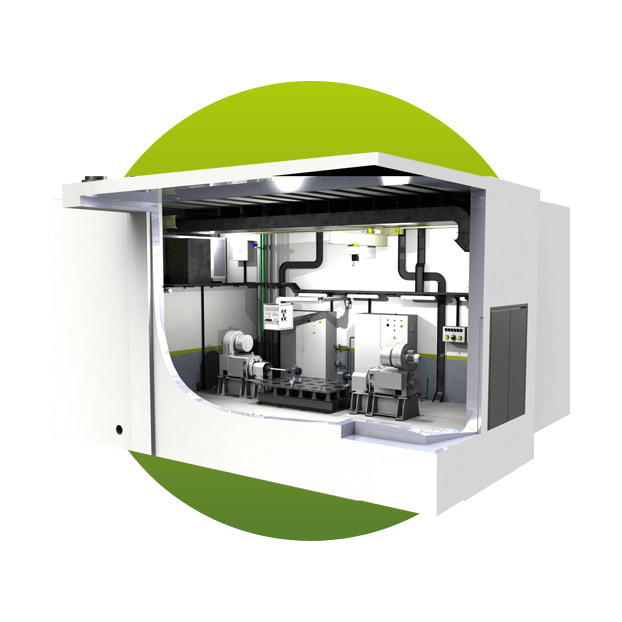
E-axle
In this configuration, this is not only the e-motor that is tested but the complete drive chain. It permits, in the downstream steps of the development, to test the complete system. The calibration of the inverter is done, with the goal to increase the global efficiency of the system. Power analysis is needed. ENORISE operates, plans and implements state of-the-art e-axle test beds. This involves the use of ENORISE dynamometers and conditioning systems, as well as tailor-made solutions for customer-specific requirements. Here again, the MORPHEE® automation system offers a high degree of flexibility and simple configuration for various e-axle test beds types.
What Is an E-Axle Test Bench?
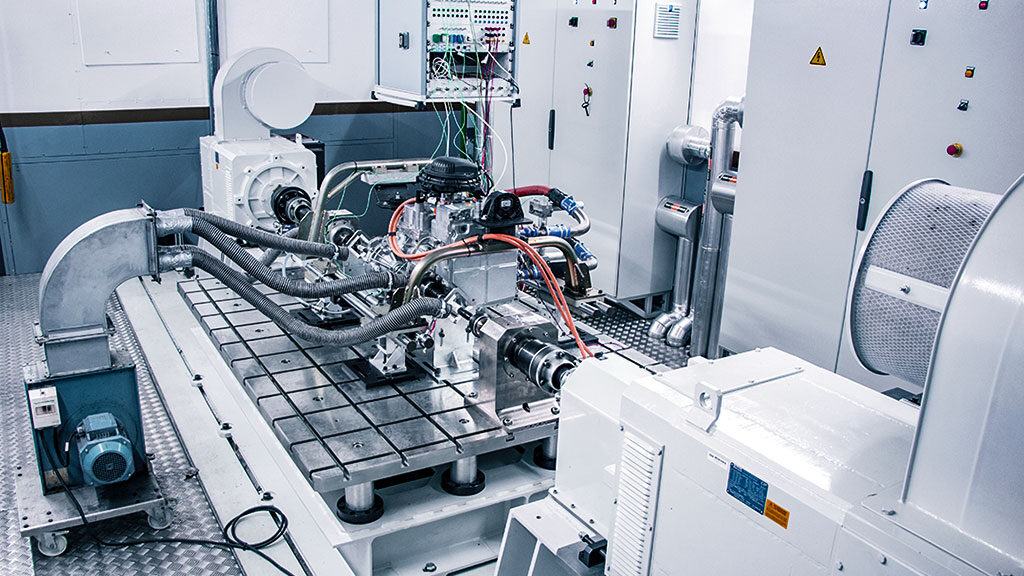
An e-axle test bench is a dedicated system used to validate the complete electric drivetrain, including the motor, inverter, reducer, differential, and all related subsystems.
Where an e-motor bench focuses on characterizing the motor alone, an e-axle bench evaluates the entire traction chain, enabling:
- Accurate performance and efficiency mapping
- Dynamic torque and speed testing
- Calibration of control strategies (EMS, torque distribution, safety logics)
- Thermal behavior validation
- NVH (Noise, Vibration, Harshness) assessment
By replicating real driving conditions in a controlled laboratory environment, OEMs reduce development time, limit road-testing efforts, and improve repeatability.
Main Challenges in E-Axle Testing
- High torque and speed levels: E-axles, especially for heavy-duty vehicles, require robust mechanical integration and load machines capable of delivering very high torque and precise speed control.
- Thermal and climatic constraints: Electric drivetrains are highly sensitive to temperature. Test benches must manage coolant flow, oil temperatures, inverter cooling, and environmental conditions, sometimes down to –40°C.
- Noise & vibration sensitivity: The reducer, differential, and motor emit characteristic frequencies that require accurate NVH measurement, rigid mechanical structures, and controlled acoustic environments.
- Safety in high-power environments: Rotating parts, high voltages, and thermal loads demand advanced safety solutions, such as full enclosures, fire detection, and integrated supervision systems.
- Flexibility for multiple architectures: OEMs develop diverse e-axle configurations. Test benches must adapt rapidly: wheelbase, inverter type, cooling strategy, voltage levels, and test scenarios.
ENORISE's Offer
ENORISE designs and delivers turnkey e-axle test benches for both light vehicles and heavy-duty platforms, combining robust mechanical engineering with state-of-the-art automation and energy management.
1. Light Vehicle E-Axle Test Benches
Our LV benches are modular, scalable, and designed to support the rapid evolution of electric passenger vehicles.
Typical applications
- Efficiency and performance mapping
- E-axle benchmarking
- Inverter and EMS calibration
- Endurance and durability cycles
- NVH characterization
Key capabilities
- Torque up to ~3,000 Nm
- Speeds up to ~3,000 rpm
- Adjustable wheelbase and multiple mounting interfaces
- Advanced water and oil conditioning (automatic fill & drain)
- High-accuracy power measurement
- Climate options: climatic chamber or hood (-40°C to +80°C)
- Battery simulation with dynamic regenerative capabilities
- MORPHEE® automation for precise control, simulation, and calibration
2. Heavy-Duty E-Axle Test Benches
For trucks, buses, and industrial mobility platforms, ENORISE has developed high-performance benches engineered for extreme torque and highly dynamic operation.
Why direct-drive matters?
- Eliminates reducer maintenance
- Increases system stiffness for more accurate NVH analysis
- Improves operational robustness and reliability
Why multidrive matters?
- Significant reduction in electrical infrastructure
- Synchronized torque/speed control across several machines
- Smaller footprint and improved energy efficiency
Key capabilities
- Direct-drive architecture without gear reducer
- Load machines up to 40,000 Nm
- Multidrive control: one drive powering up to three machines
- Reduced electrical infrastructure and energy consumption
- Custom dynamometers and inverter modules
- Optimized compact layout for constrained environments
- MORPHEE® automation with embedded dynamometer control
Proven field experience
Our heavy-duty benches operate in high-load, high-power industrial environments and have demonstrated their ability to test complete electric truck powertrains efficiently and reliably. They result from ENORISE’s mastery of mechanical, electrical, fluid, and automation integration—combined with strong collaborative engineering with key technology partners.
Benefits of ENORISE’s Approach
- Complete driveline validation Test the entire system—motor, reducer, differential, inverter, and controls—under representative load cases.
- High flexibility Adapt your bench to future architectures, voltage levels, cooling strategies, and wheelbases.
- Superior automation MORPHEE® enables deterministic real-time control, HIL integration, and advanced test sequence automation.
- Reduced time-to-market Optimized workflows, battery simulation, and automation accelerate calibration and validation activities.
- Lower operational costs Energy-efficient multidrive systems and direct-drive architecture reduce maintenance and electrical consumption.
- Strong references ENORISE has delivered complete turnkey e-axle benches—including multi-bench test centres—used today by major OEMs in the passenger-car and heavy-duty sectors (without naming them here for confidentiality). These references demonstrate the scalability, reliability, and industrial maturity of our solutions.
FAQ - E-Axle
What types of tests can be performed on an e-axle bench?
Efficiency mapping, durability, thermal tests, transient torque/speed tests, NVH, regenerative braking, inverter calibration, and more.
How is an e-axle bench different from an e-motor bench?
An e-motor bench tests the motor + inverter only, while an e-axle bench validates the complete driveline, including mechanical components such as the reducer and differential.
What torque and speed ranges are available?
- Light vehicles: up to ~3,000 Nm
- Heavy-duty: up to 40,000 Nm
Custom ranges are possible for specific applications.
Can ENORISE integrate climatic testing?
Yes. We provide climatic hoods or chambers with ranges down to –40°C, as well as advanced coolant and oil conditioning.
What safety solutions are available?
Either adaptation of an existing cell (with fire detection, ventilation, containment) or full protective enclosures designed for high-power rotating equipment.
Contact our e-Axle experts